







Natav Hendin (1), Amit Shachak (1), Dorit Asher, (1), Eran Hadar(1), Yael Benyamini (2) & Sharon Perlman(1)
Affiliations:
1. Rabin Medical Center
2. Tel Aviv University
Objective
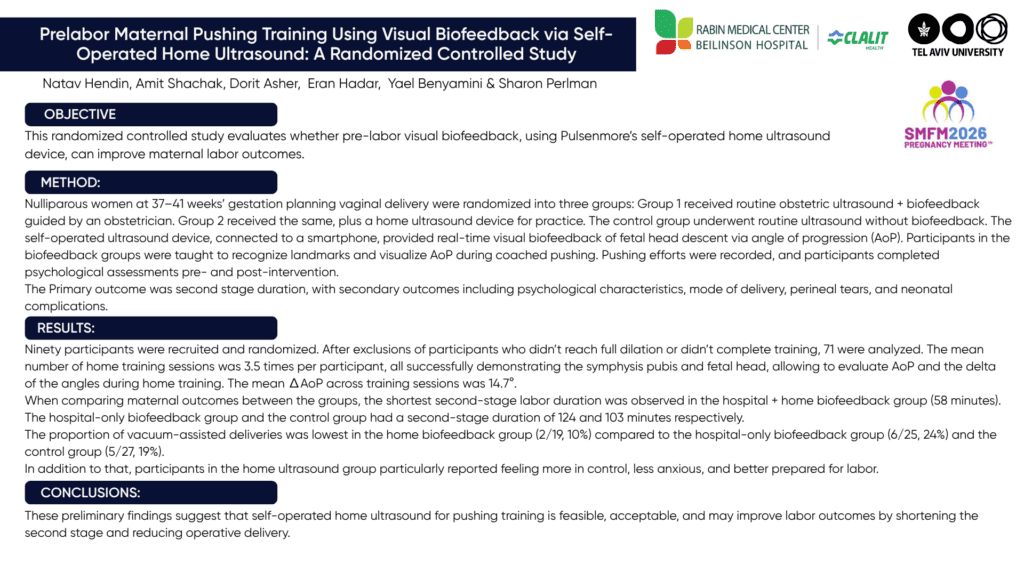
This randomized controlled study evaluates whether pre-labor visual biofeedback, using Pulsenmore’s self-operated home ultrasound device, can improve maternal labor outcomes.
Here we demonstrate insights from three years of research and real-world application
Method
Nulliparous women at 37–41 weeks’ gestation planning vaginal delivery were randomized into three groups: Group 1 received routine obstetric ultrasound + biofeedback guided by an obstetrician. Group 2 received the same, plus a home ultrasound device for practice. The control group underwent routine ultrasound without biofeedback. The self-operated ultrasound device, connected to a smartphone, provided real-time visual biofeedback of fetal head descent via angle of progression (AoP). Participants in the biofeedback groups were taught to recognize landmarks and visualize AoP during coached pushing. Pushing efforts were recorded, and participants completed psychological assessments pre- and post-intervention.
The Primary outcome was second stage duration, with secondary outcomes including psychological characteristics, mode of delivery, perineal tears, and neonatal complications.
Results
Ninety participants were recruited and randomized. After exclusions of participants who didn’t reach full dilation or didn’t complete training, 71 were analyzed. The mean number of home training sessions was 3.5 times per participant, all successfully demonstrating the symphysis pubis and fetal head, allowing to evaluate AoP and the delta of the angles during home training. The mean ∆AoP across training sessions was 14.7°.
When comparing maternal outcomes between the groups, the shortest second-stage labor duration was observed in the hospital + home biofeedback group (58 minutes). The hospital-only biofeedback group and the control group had a second-stage duration of 124 and 103 minutes respectively.
The proportion of vacuum-assisted deliveries was lowest in the home biofeedback group (2/19, 10%) compared to the hospital-only biofeedback group (6/25, 24%) and the control group (5/27, 19%).
In addition to that, participants in the home ultrasound group particularly reported feeling more in control, less anxious, and better prepared for labor.
Conclusion
These preliminary findings suggest that self-operated home ultrasound for pushing training is feasible, acceptable, and may improve labor outcomes by shortening the second stage and reducing operative delivery.