








The way prenatal care is delivered is changing. Healthcare systems around the world are exploring how digital technologies, remote monitoring and artificial intelligence can help expand access to care while maintaining high clinical standards.
This month, we highlight three developments that reflect this broader shift.
Can part of high-risk pregnancy monitoring move beyond the clinic?
Supporting hybrid prenatal care programs
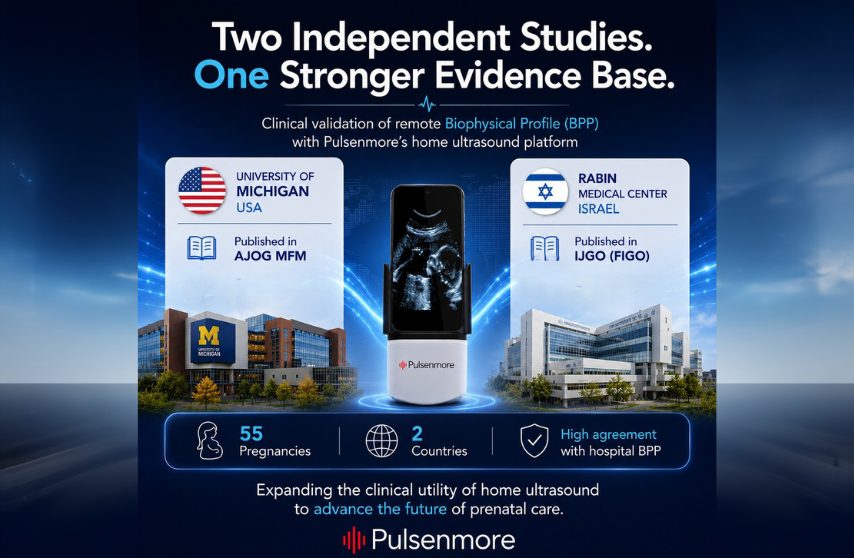
The Biophysical Profile (BPP) is a cornerstone of fetal surveillance in high-risk pregnancies. Because many patients require frequent assessments, BPP places a significant burden on both families and healthcare systems. This has led researchers to ask an important question: Can components of the assessment be performed at home without compromising clinical quality?
Two independent studies published in the past weeks, one from Rabin Medical Center and another from the University of Michigan, evaluated clinician-guided home ultrasound for remote BPP.
Although conducted independently and in different healthcare systems, both
studies reported high agreement with conventional in-clinic assessments, contributing to the growing body of evidence supporting hybrid models of prenatal care.
📖 Read the publication
Pulsenmore partners with Ouma Health
Across the United States, healthcare providers are increasingly adopting virtual maternity care models that combine in-person visits with remote monitoring to improve access, continuity of care and patient experience.
Pulsenmore and Ouma Health recently announced a strategic collaboration to integrate home ultrasound into Ouma’s digital pregnancy care model.
The collaboration reflects a broader industry trend toward a connected prenatal care ecosystem that enables clinicians to deliver high-quality prenatal care beyond the clinic, reducing barriers created by time and distance.
Bringing AI into healthcare requires more than algorithms
AI is already transforming healthcare.
Yet developing an AI model is only the beginning. Demonstrating clinical validity, building regulatory confidence and establishing safe implementation pathways are equally essential.
Pulsenmore has been selected to participate in Israel’s Healthcare AI Regulatory Sandbox Program, led by the Israel Innovation Authority and the Ministry of Health.
The program brings together regulators, clinicians and technology companies to establish frameworks for developing and validating AI applications in healthcare, helping bridge the gap between innovation and clinical adoption.
Thank you for visiting the Pulsenmore booth at MTAA, BFCA and FMF.
We enjoyed meeting so many clinicians and discussing the future of maternal-fetal medicine.
See you next at:
ISUOG World Congress, London | 4-7 September 2026
SMFM Europe, Utrecht | 7-10 October 2026
RANZCOG, Sydney | 12-15 October 2026
Warm regards,
The Pulsenmore Team