







Liat Mor, MD1, Hagit Eisenberg, MD1, Liliya Tamayev, MD1, Daniel Tairy, MD1, Ben Oren, MD1, Yael Ganor Paz, MD1, Michal Levy, MD1, Eran Weiner, MD1, Giulia Barda, MD1
1Department of Obstetrics & Gynecology, the Edith Wolfson Medical Center, Holon, Israel, affiliated with the Faculty of Medicine, Tel Aviv University, Tel Aviv, Israel
Abstract
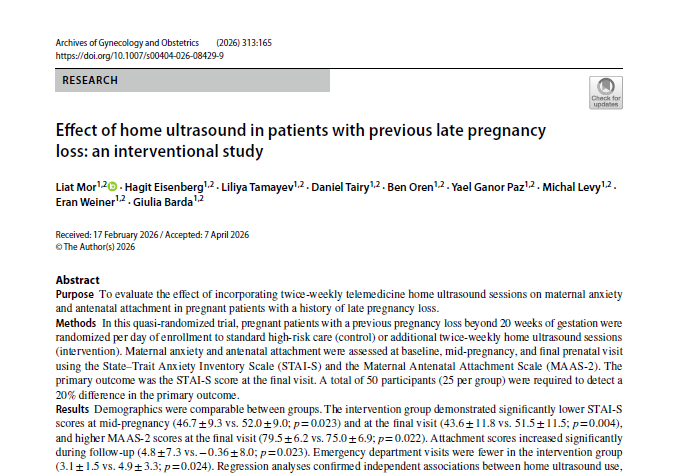
Purpose To evaluate the effect of incorporating twice-weekly telemedicine home ultrasound sessions on maternal anxiety
and antenatal attachment in pregnant patients with a history of late pregnancy loss.
Methods In this quasi-randomized trial, pregnant patients with a previous pregnancy loss beyond 20 weeks of gestation were
randomized per day of enrollment to standard high-risk care (control) or additional twice-weekly home ultrasound sessions
(intervention). Maternal anxiety and antenatal attachment were assessed at baseline, mid-pregnancy, and final prenatal visit
using the State–Trait Anxiety Inventory Scale (STAI-S) and the Maternal Antenatal Attachment Scale (MAAS-2). The
primary outcome was the STAI-S score at the final visit. A total of 50 participants (25 per group) were required to detect a
20% difference in the primary outcome.
Results Demographics were comparable between groups. The intervention group demonstrated significantly lower STAI-S
scores at mid-pregnancy (46.7 ± 9.3 vs. 52.0 ± 9.0; p = 0.023) and at the final visit (43.6 ± 11.8 vs. 51.5 ± 11.5; p = 0.004),
and higher MAAS-2 scores at the final visit (79.5 ± 6.2 vs. 75.0 ± 6.9; p = 0.022). Attachment scores increased significantly
during follow-up (4.8 ± 7.3 vs. − 0.36 ± 8.0; p = 0.023). Emergency department visits were fewer in the intervention group
(3.1 ± 1.5 vs. 4.9 ± 3.3; p = 0.024). Regression analyses confirmed independent associations between home ultrasound use,
reduced anxiety, and improved attachment.
Conclusion Telemedicine home ultrasound significantly reduced maternal anxiety and improved antenatal attachment in
patients with prior late pregnancy loss. This reassurance strategy may also decrease unscheduled emergency visits, supporting
its integration into standard prenatal management in this vulnerable population.
Keywords Stillbirth · Pregnancy loss · Telemedicine · Anxiety · Attachment