








Newman R1. , Kalafat E2,3. , Platt D. L.4 , Little S5. , Aghajanian P4. , Chopra R.6 B. , Trychon K.6 , Tavella N.7 Shtrichman R.8 , Bianco A.7
Affiliations:
1. Division of MFM, McGovern Medical School at UTHealth, Houston, TX
2. Division of Reproductive Endocrinology & Infertility, Koc Uni. Hospital, Istanbul
3. Dept. of OBGYN, East Virginia Medical School, Norfolk, VA
4. MFM, Beth Israel Deaconess Medical Center, Boston, MA
5. Center for Fetal & Maternal Ultrasound, UCLA School of Medicine, LA, CA
6. Dept. of MFM, Brigham & Women’s Hospital, Boston, MA.
7. MFM, Icahn School of Medicine at Mount Sinai, NY
8. Pulsenmore LTD. Omer, Israel
Objective
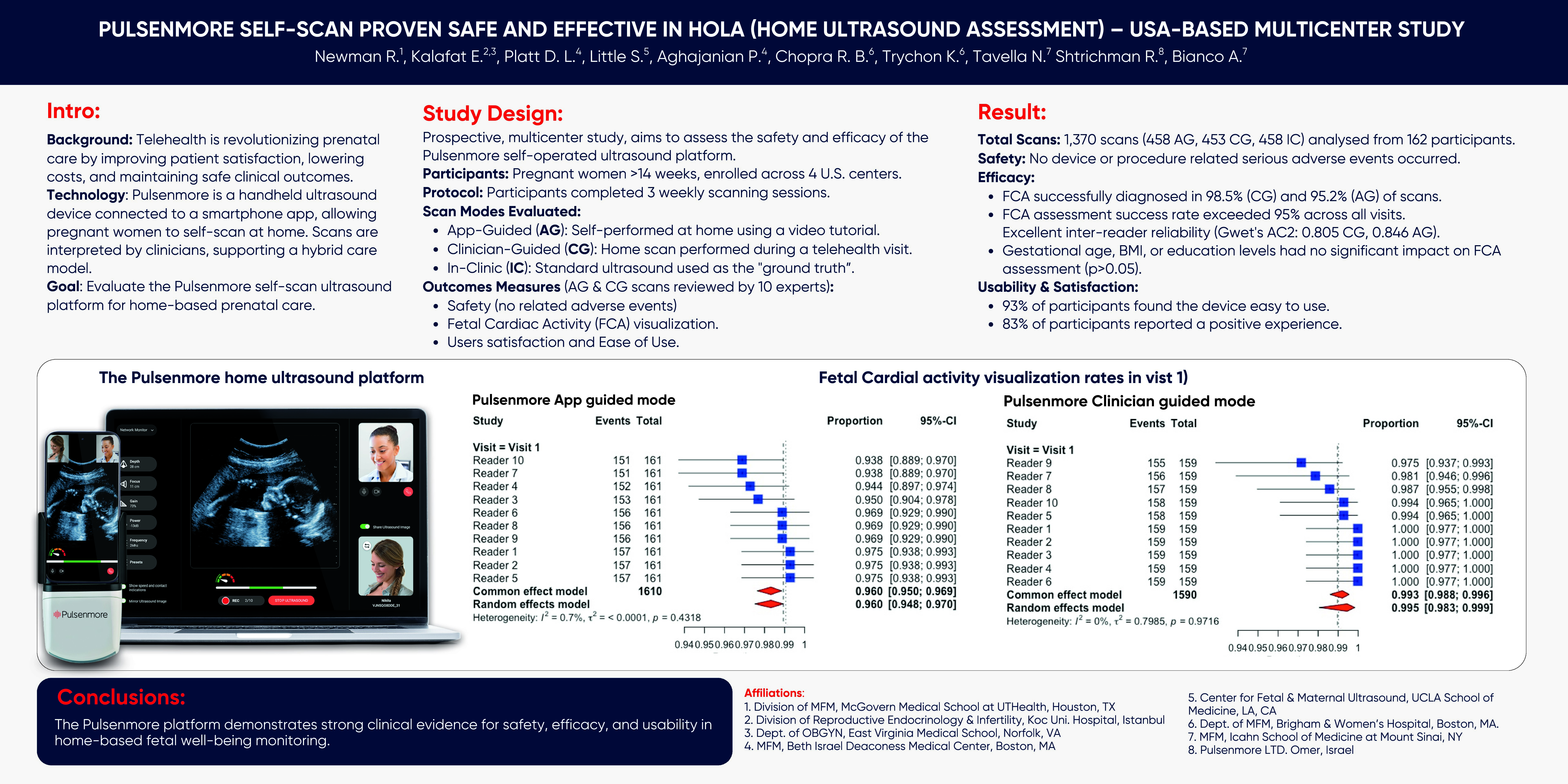
Telehealth has become a transformative force in prenatal care, enhancing maternal satisfaction, reducing costs, and increasing efficiency without compromising safety or outcomes. The Pulsenmore home ultrasound is a handheld device connected to smartphones and guided by a mobile app, enables women to perform high-quality ultrasound scans at home. These scans are securely transmitted to clinicians, enabling a hybrid care model that combines remote monitoring with in-clinic expertise.
Here we demonstrate insights from three years of research and real-world application
Method
Clinical studies and real-world data analysis from hospitals and HMO home ultrasound services have been summarized and presented here.
Results
Several studies have validated the Pulsenmore device’s feasibility, safety, and user acceptance. A study with 100 pregnant women demonstrated its effectiveness in detecting fetal heartbeat, movement, and amniotic fluid volume (AFV), with high satisfaction. A pivotal multicenter study in the USA confirmed these results. Real-world data in Israel showed over 98% precision in detecting prenatal parameters across 170,000+ scans. In Germany, studies confirmed the device’s acceptance and image quality for assessing AFV and fetal heartbeat, showing high patient satisfaction and potential to reduce outpatient visits.
Validation studies confirmed the device’s reliability and accuracy in measuring fetal heart rate and maximal vertical pocket, as well as its capability to conduct remote Biophysical Profile tests for high-risk pregnancies.
The device’s potential was demonstrated in monitoring high-risk pregnancies, reducing anxiety and ER visits for women with previous pregnancy loss, and managing gestational diabetes. Real-world utilization data indicate successful home admission of women with high-risk pregnancies.
Conclusion
The Pulsenmore platform offers a safe, effective, and patient-centered solution for prenatal monitoring. Clinical evidence from three years of research and successful commercialization supports its integration into prenatal care.